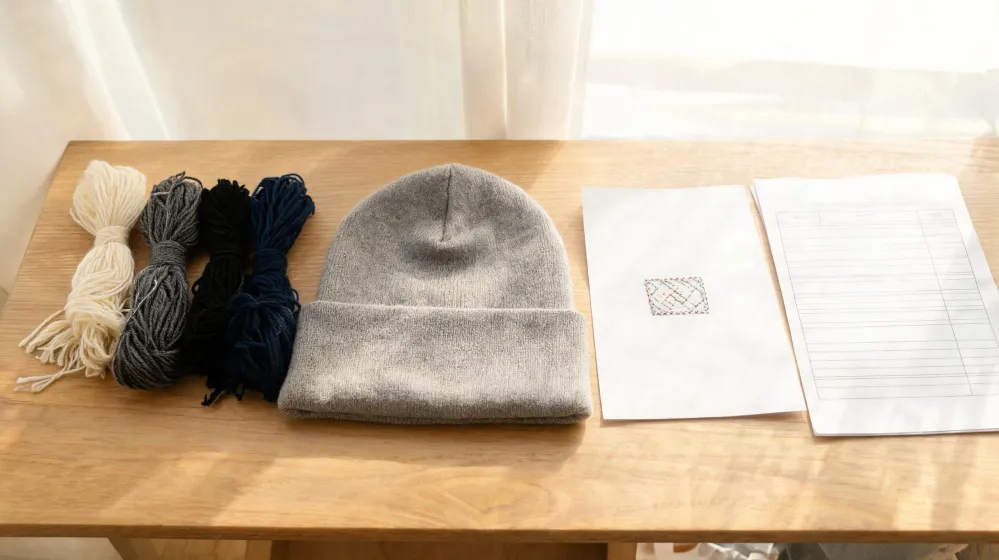
A custom beanie brief that describes the product only as "knit beanie, one size" is a purchase order written against nothing. The sample comes back in a silhouette nobody agreed on — a shallow crown where a deeper slouch was expected — and the buyer funds a second sample round out of a calendar with no slack. Quality control then has no written criterion to reject against: you cannot fail a hat for the wrong cuff when the brief never named a cuff. The second round costs money; the approval that was never written down costs more.
The fix is two fields locked before the first email: style and color on page one, and a material line copied from that style's own description rather than pooled across the category. A cuff — the folded band at the hem — and a pom-pom, the yarn ball anchored at the crown, change trim and construction, so one material sentence cannot honestly cover both. What follows is the order in which a sourcing team builds that document, and how the same paper gets used at the sample gate.
What a Sloppy Beanie Brief Costs You
The failure chain is predictable, and it starts before any supplier is contacted. A brief leaves the style open, so the document has to carry one generic material line to fill the gap. The supplier, quoting against a line that fits any silhouette, prices the cheapest construction that satisfies it. The sample arrives in a different knit weight and a different trim than the buyer had in mind, and the review turns into a discussion about what was probably meant.
Every step in that chain spends something hard to buy back. A second sample round pushes the launch calendar, and the rounds are sequential: the second cannot start until the first has been argued about and returned. Internal approvals queue again behind it. The quiet cost is the precedent — once a sample passes against a brief that never named the style, the approved sample becomes the de facto specification, and the written document trails behind a physical object nobody described.
That chain is described qualitatively on purpose. No quote, minimum order quantity, capacity review or lead-time commitment sits behind this text, so none of those numbers belongs in a brief template. What a template can do is make each failure visible early enough to fix in writing.
Day One Locks Style and Color First
The stored manufacturer catalog page for custom beanies opens with one instruction, and it is not about fiber: browse the catalog and pick your beanie and its color. Fiber is the wrong starting question. The style entry decides which material list is even relevant.
The same page lists cuffed beanies and pom-pom beanies as separate options that offer both warmth and style. That sentence carries the structural point. A cuff and a pom-pom are not colorways of one product; they are different constructions with different trim, and each carries its own description further down its own page. Style and color therefore take the first two fields of the brief, and they take them on day one, before any material conversation starts.
Treat warmth as the page's own marketing wording, not as a measured claim. Nothing in that text is a thermal test, and a brief that repeats the word as a requirement is asking a supplier to certify a feeling. The captured page is also one platform's Canadian catalog path — useful as a reference for how a per-style description is structured, and not a statement about any particular factory's capability.
Week One Pulls the Material From the Style Page
The exact materials do not sit on a category page. The instruction is to scroll down the product page to the description section — which is where the composition line lives, and that placement is the whole lesson: the material line is bound to one style entry, not to the category.
Pool one line — cotton, acrylic and wool in a single sentence labelled warm knit — across three styles, and the only field that could have been compared against a returned sample has been dissolved. What remains is a sample that either looks acceptable or does not, judged by whoever is standing in the room.
By the end of the first week, the material field should read as a copy, not a summary. Copy the composition wording from the chosen style's own description word for word, and attach the source URL and the date the page was captured beside it. Paraphrase is where drift enters: "mostly acrylic" and a composition line listing percentages are not the same instruction, and only one of them survives a side-by-side comparison with a returned hat.
Keep the scope honest in both directions. A description attached to one style says nothing about a second style, and it says nothing about a different supplier's version of the same silhouette. It is a starting specification to be confirmed per line item, not a general promise that travels with the product name.
Week Two Compresses Everything Into One Brief
By the second week the document has to shrink. One style. One color. The material line already pulled from that style's page. A written clause asking each candidate supplier to confirm every line item before quoting.
That short list earns its extra page because each field cancels a specific argument later — the single style makes every sample defect point at a named field instead of at a recollection, the material line lifted from the style's own page removes the drift between what was ordered and what gets inspected, the confirmation clause surfaces a supplier's variance inside the quote rather than in a sample that lands afterwards, and an acceptance sheet mirroring the brief field for field lets QC reject against the buyer's own words, none of which binds a supplier until a factory answers in writing.
A brief that skips the confirmation clause still gets quotes, which is the trap. Silence in a quote reads as agreement until the sample shows otherwise, and by then the buyer is negotiating against a document that never asked the question. Sending the clause costs one paragraph and one round of replies.
Weeks Three and Four Decide Sample Approval
Suppose the sample lands in the third week and the review happens at a table with the brief laid beside it. Style first: crown depth, cuff or no cuff, pom-pom present or absent, and whether the trim matches the option named on page one. Color second, against the color field, not against a memory of the mockup. Material third, reading the returned hat's composition claim next to the copied line. Trim again at the end, because cuffs and pom-poms are where substitutions hide.
With no lab testing on the table, the brief is the only written ground for rejection. If the returned knit does not match the material field written for that style, the reviewer holds a documented mismatch; without the brief, the same reviewer holds an opinion, and opinions lose to shipping schedules.
No physical sampling, third-party test or wear trial stands behind this article. Durability, UV resistance, antibacterial treatment and warmth comparisons cannot be inherited from a catalog's marketing text, so they belong in the brief as written questions to the candidate supplier — which test method, run by whom, reported how — and the answers get filed with the sample rather than assumed from it.
Three Months Later the Brief Still Runs Reorders
A strict brief slows the first quote. The supplier answers line by line instead of matching a familiar phrase, and that costs a reply cycle. A loose brief quotes faster and pays the difference back in extra sample rounds, repeated internal approvals and rework — none of which appear as a line item on anyone's sheet.
Three months later the same document does a second job. The reorder gets placed against the brief, not against a memory of the approved sample, and the difference between a smooth reorder and a repeat of the original argument is whether the material line was written before the first sample or reconstructed after it. Version the document and keep the original composition line attached to the current version, so a later color addition does not quietly rewrite the specification underneath it.
Today, open the product page of the single style you are closest to ordering, scroll to its description, and copy that composition line into the material field of your brief exactly as written, with the page URL and today's date beside it. Then send it with one written question per line item, starting with the material: confirm this composition for this style and this color. The first reply back is your first real specification check.
