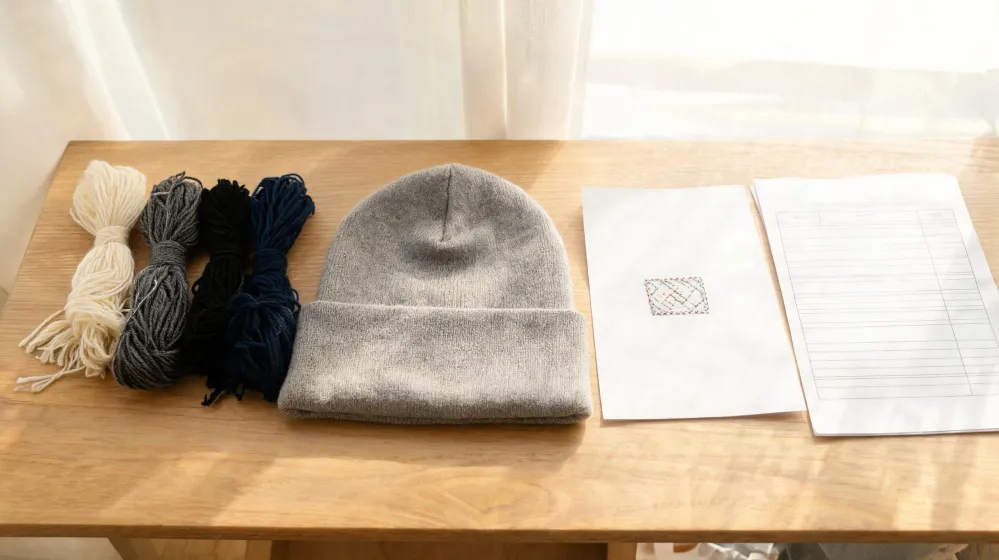
Reviewing a custom beanie proof is a two-item check, not a taste call: where the negative space sits and which thread color changed. Both are settled before the file reaches you, so a signature without those two lines in it hands your supplier two decisions you never actually approved.
Negative space is not empty paper: it is the area where the hat's own fabric shows through. A color your supplier does not stock gets swapped for the closest match on its available list. Neither arrives flagged, so both have to become written spec lines before the file is approved.
What Negative Space Shows On A Beanie Proof
Negative space is not the absence of decoration. Negative spaces are empty spaces in design where the fabric will be seen through, which puts the knit, the base color and whatever seam runs beneath the artwork inside the definition of what you are buying.
On a beanie that exposed area curves around a crown, so it is never a flat window. Two hats built from the same artwork can show a different open area because the knit sits and the cuff seam lands differently, which makes it a spec question rather than an aesthetic one.
Reading the stored guide text closely, I noticed the sentence is about fabric being visible, not about ink or stitches. That decides where every later check lands: on the cloth under the design, not on the file that drew it.
Ask which face of the hat the open area falls on and whether a seam crosses it, then pin the answer to the artwork revision number. Without that link, a later file swap moves the open area and nobody notices.
When Your Thread Color Isn't Available
Upload a design containing a color the supplier does not have and the tool picks the closest match from the available colors. The proof comes back looking resolved, and the substitution has already happened inside the file.
Suppose you source against a color-card number and the candidate supplier runs a limited thread library. A swap is close to certain; the open question is whether anyone wrote down which original became which. Compare cell by cell instead of scanning the whole.
Small areas lose first. Working through proofs against a color list, I have found the accent colors easiest to miss, a badge outline or a single highlight inside a wordmark, because a nearest match reads as acceptable at that scale.
Check against the file you submitted, not against memory. If a proof color is not in your original list, treat it as a substitution until the supplier states otherwise in writing.
Should You Fill The Empty Space
The documented fix for open areas is to fill the empty space with color. It also changes what you are buying: the cloth goes from visible to covered, which shifts density and visual weight on a knit surface.
A fill is a design change, not a correction. That classification decides who signs off, because a correction can be handled by whoever runs the proof and a change cannot.
Imagine a wordmark that only holds its shape because the base fabric forms the counter of a letter. Fill that counter and the mark loses its outline; leave it open and you accept the knit and the seam running through it. Either version can be the right answer, and neither is right by default.
Get the approved version named on the proof sheet, with the approver's name next to it. A decorator who settles that call alone is making a design decision on your behalf and charging you for the outcome.
The Proof Review Order, Step By Step
Method first. Confirm the decoration process in writing and get the current available thread color list before you open the proof, because the library your supplier quotes from can differ from the one the proof file was rendered against, and every later comparison depends on knowing which list you are comparing to.
Then locate every negative space area and mark each one on the proof.
After that, work the substituted colors one at a time against your original list, one row per color with the original code on the left and the proof color on the right, since a page-level glance will pass a swap that a line-by-line pass catches.
I ran this order a second time on the same proof and found that skipping the first step and going straight to the visual left the color check with no reference point. The comparison felt fine and proved nothing.
Write the mapping and the open-area handling into one record that carries the same revision as the proof. Sign, or send it back, only after that record exists.
What Each Proof Step Must Catch
Every step has one thing it must catch, and a step that produces no written answer is not finished. Locating negative space has to end with which face of the beanie body shows through and where the seam crosses it; a note saying open area at front catches nothing.
The color pass has to end with a pairing: this original code became that available color. Not close enough, not a tick in a box, a pairing.
The fill decision has to end with a classification, design change or correction, because the two carry different approvals and set different expectations for the bulk run.
A step that ends with a blank becomes a question to the supplier rather than an assumption written onto the proof. That habit is what makes the sequence repeatable on the next style you source.
How To Confirm The Proof Is Right
Confirmation is a document, not a second look at the image. Ask for the original-to-substitute table plus one line per open area stating whether it stays exposed or gets filled. A supplier who cannot produce the table has not finished the proof.
The table caught what the image hid: two areas that read as one color on the proof were the same substitute standing in for two different originals. On screen that looked like consistency; on paper it was a shortcut.
Scope the claim honestly. This is file-stage approval, and it settles what the proof commits to, nothing about how the finished hat wears after a winter of use.
Where The Guide Ends And The Supplier Starts
The stored guidance is one platform's graphics documentation for its own catalog, and its processes and options belong to the selected product on the selected regional page. It does not carry over as a general promise from any factory, and I would not offer it as one to a sourcing team.
What this material does not give me: quotes, minimums, a capacity audit, lead-time commitments or certification reports from any candidate supplier, and no physical sample or third-party test has been run. Durability, UV performance, antimicrobial treatment and environmental claims stay outside what a file review can establish, so they belong in questions rather than in a spec sheet assembled from marketing text.
Written as a one-page question list, I noticed the vague parts of supplier replies got easier to point at. A supplier who answers that colors are matched closely has said nothing about which code reaches the machine.
One thing to confirm before you sign: which original thread color became which available color, and which face of fabric the open area exposes. Both are settled at proof stage and neither can be reconstructed from finished goods afterwards.
